Forum Replies Created
-
AuthorPosts
-
Hello Het,
In the directory where uSimmics is installed there is a subdirectory named “doc” in which you find the file “technical.pdf”. This contains a detailed description of all calculations used in uSimmics. The calculation you are interested in is on page 38 under “4.6.2 Gain”. I am not sure if your own calculation is different.
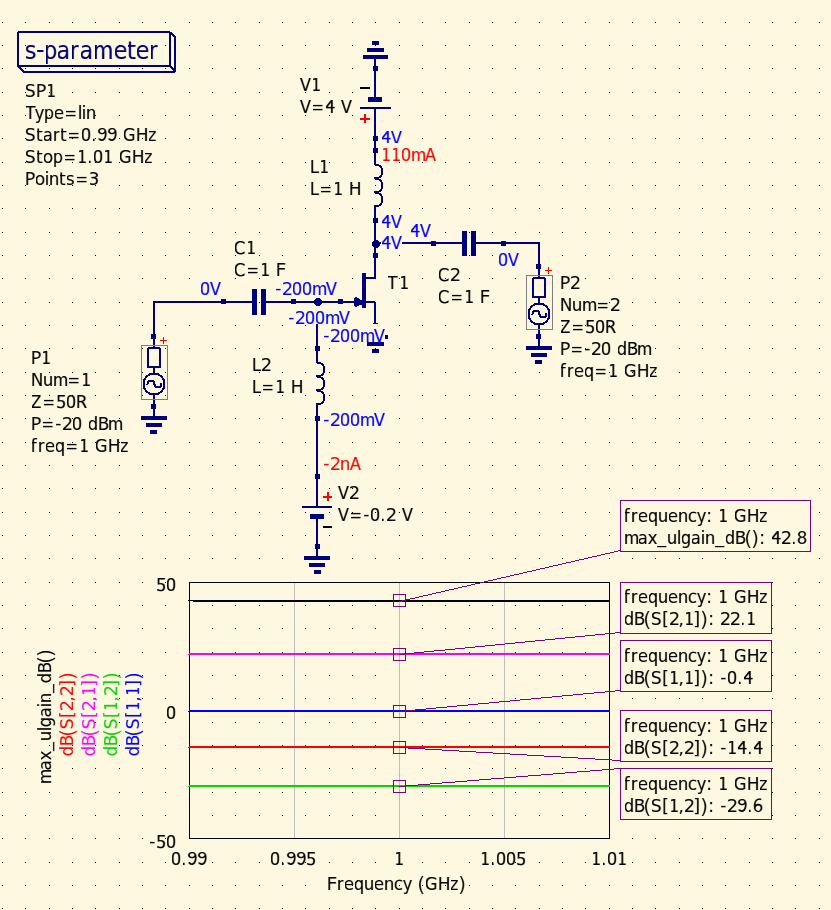
In a first step I recommend in this case not to use the s2p-file to get S-parameter values but to use a diagram to plot all parameters and set markers. Moreover, for doing hand calculations I suggest to use uSimmics itself. In a diagram you can plot a graph defined by your own equation and add a second graph with the max_ulgain_dB(S) function for comparison. That makes it easy to check if your own formula is different from the one used by uSimmics. I did not define an equation in the attached simulation but you certainly get the idea.Regards
Max
Attachments:
27. February 2026 at 22:41 in reply to: Error of transmission line simulations, problem with msvcp100.dll #9222Hello Tom,
I had the same problem and there was no straightforward solution.
The FAQ on qucsstudio.de states what to do: “[…] start winecfg. In the Library tab add msvcp100 and msvcr100 and set them to native.” But that did not help on my PC, and some other users said so as well. After trying lots of things I found a solution: Directly (!) after adding msvcp100.dll and msvcr100.dll to winecfg I set them to “Native, Buitlin” and not “Native” as stated in the FAQ. Then uSimmics works flawlessly on my PC. The weird thing is that after setting the DLLs to anything else than “Native, Buitlin” it resulted on my machine in the sinh/cosh-error which persisted even after setting back to “Native, Buitlin”! The only solution then was to remove both DLLs from winecfg and add them again with the setting “Native, Buitlin”.
I can reproduce this strange behaviour of Wine on my PC (Wine 9.0/Linux Mint 22) with uSimmics 5.8 and 5.9. Since I found the solution I worked a lot with uSimmics under Linux. I can highly recommend it to anyone in RF.
-
AuthorPosts